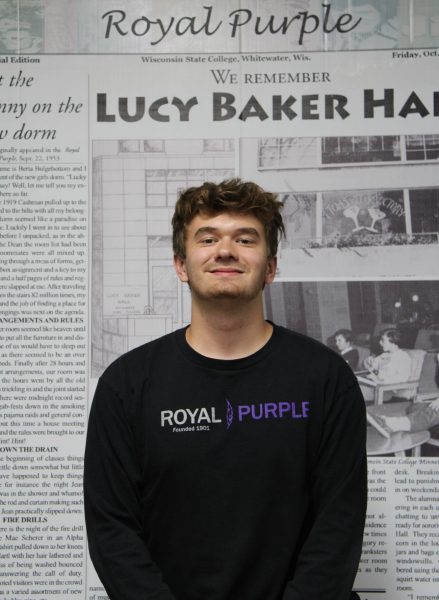
The Royal Purple celebrated its 124th anniversary Nov. 1, inching closer to a milestone 125 years as the University of Wisconsin-Whitewater’s primary source of print news. Since its inception, the organization has served as an opportunity for students to receive journalistic experiences and has archived generations of Warhawk history.
The newspaper started in November 1901 as a literary magazine for the State Normal School at Whitewater. A story titled “Some Signs of Winter” grazed the front page, making readers aware of the changing forecasts and predictable weather patterns. Editor-in-chief Charles B. Woodstock ran the newspaper like a typical early 1900s publication, reporting on local news and showcasing short stories, with advertisements and class notes tucked in the back.
In the paper’s greeting, the writer described that the publication needed to “receive the hearty contributions and support of the student body, alumni, and faculty” to be successful.
“Are you ready now to put your shoulder to the wheel and help make this, our latest and perhaps our greatest undertaking, a success?” the first issue read.
At the time, single copies cost 8 cents to subscribers and 10 cents for non-subscribers. People could subscribe to Royal Purple for 50 cents a year. Subscription prices quadrupled to $2 a year by the Royal Purple’s 25th anniversary.
Instead of celebrating the milestone, Royal Purple highlighted a questionable future on the front page of the Nov. 1, 1926 issue. Only 28 percent of students subscribed to the newspaper that year, which was not enough for it to operate without a deficit.
Brian Schanen, College of Arts and Communication forensic advisor and lecturer, pointed to an increase in competition across the country as a contributor.
“In the early 1900s, we had a very aggressive investigative press, the muck press,” said Schanen, who teaches History of Mass Communication at UW-W. “Newspapers were fighting for readers, so they were doing a lot of investigations.”
Fortunately, the organization continued to produce, despite only a seven-person staff on its 50th anniversary. That same year, UW-Whitewater was named Wisconsin State College-Whitewater. By becoming a Wisconsin State College, the university could begin offering Liberal Arts degrees to its students, sparking a rise in production quality and staff quantity.
“You bring in more perspectives,” Schanen said. “We have a Dunkin’ Donuts coming to Whitewater. I can very well see a business major looking at that and saying ‘what’s the impact on the economy?’ I could see a political science person saying ‘how is that going to impact the politics of the city?’ I could see an education major saying ‘how is that going to impact student diet?’ You bring in a lot of different perspectives into being able to talk about what is happening, without a bias.”
The staff size went from seven to 15 by the paper’s 60th anniversary, and then skyrocketed to 49 students by the paper’s 75th anniversary. This staff included editor-in-chief Edward Hung, a 1977 graduate who started the George Hafer Scholarship Fund at UW-W.
A multitude of changes in aesthetics took place over the next 25 years. Logo changes took place nearly every year until 1992, and the newspaper began using the school’s signature purple full-time in 1998. That same year, the organization started posting stories on the internet, beginning on uww.edu before buying its own domain, purpleonline.com.
“It used to be just a physical newsprint, but the outlets can’t get by with just that anymore,” Schanen said. “Reading the physical copy, but then also needed to figure out how to expand into online spaces. The population consumes its information in so many different ways.”
Three years later, the Royal Purple celebrated its 100-year anniversary. After 2,982 issues, the organization marked a century of upholding its legacy as the voice of UW-W students.
In 2001, the Royal Purple housed seven sections: news, editorials, features, sports, campus calendar, classifieds, and police reports. Sections have come and gone, but the impact has not.
As Royal Purple approaches 125 years of operation, older publications are hard to recognize. Since 2021, the Royal Purple has shifted to a quarterly publication schedule in print with a larger online presence; weekly issues have turned to the website.
Despite that, the changes and adaptations to modern journalism continues to solidify the importance of Royal Purple.