Sudden change is a phrase often used on the defensive side of the football, when the offense commits a turnover and the defense must quickly take the field. But for the UW-Whitewater backfield, sudden change has been a theme all season.
At Perkins Stadium, when the Warhawks run out of the smoke-filled tunnel and touch the rock before kickoff, it serves as a reminder of what brand of football fans are about to see for the next 60 minutes: pound the rock.
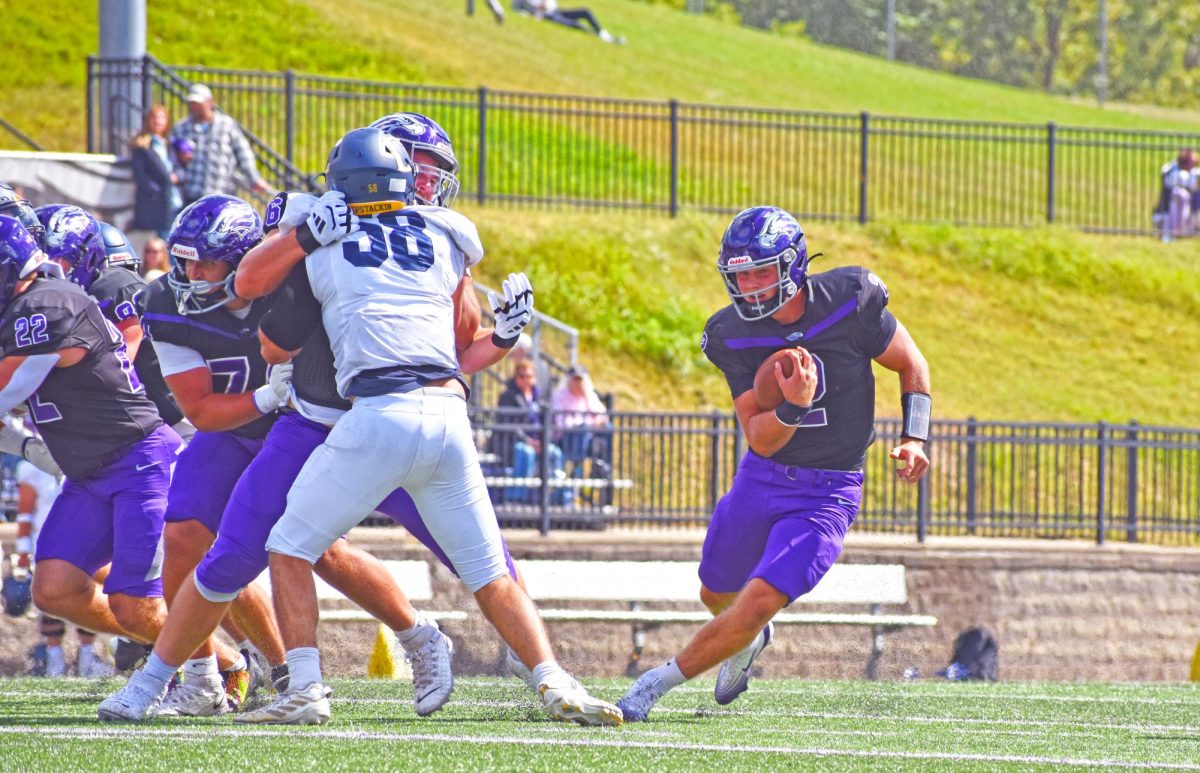
When the season began, there was a quarterback battle between junior transfer Aidan Lucero and sophomore Justin Klinkner. Klinkner quickly secured the starting job and has since led the team in rushing attempts, totaling 40 more carries than the next closest player. With new offensive coordinator Caden Murphy installing an offense built around designed quarterback runs, the workload wasn’t unexpected. And Klinkner not only accepts it, he embraces it.
“I love running the football, especially in those short-yardage situations, getting those tough yards and moving the chains,” Klinkner said.
Klinkner is a physical runner, far from the traditional quarterback who slides early to avoid contact. The added hits have not slowed him down. He logged 18 rushing attempts in the Warhawks’ most recent game, a 24-7 win over UW-Oshkosh.
“That’s something we take pride in in the QB room, taking hits and getting extra yards, getting everyone fired up and keeping momentum going,” Klinkner said. “Just trying to maintain health throughout the season is something we take seriously. Giving us the best opportunity to go out there each week and perform.”
But Klinkner isn’t the only player capable of carrying the load. The Warhawks also rely heavily on junior running backs Ty Schultz and Brian Stanton, both of whom have delivered when their number is called. The balance between the backs gives the offense flexibility and helps keep players fresh, head coach Jace Rindahl said.
“Everybody gets their opportunity, and it’s what you do with it,” Rindahl said. “It’s more of a ‘what have you done lately’ kind of thing.”
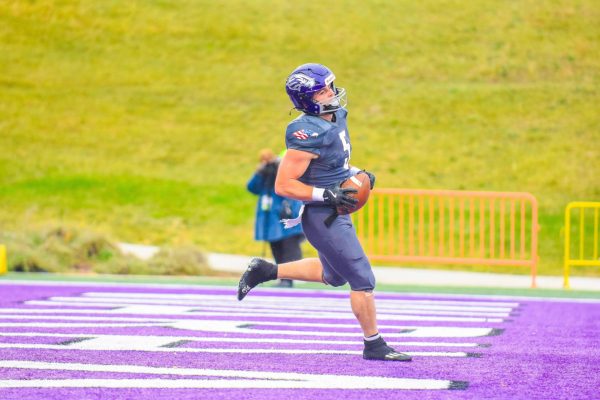
Schultz leads Stanton in carries, 96 to 93, and is coming off back-to-back strong performances, tallying 91 yards against Oshkosh and more than 170 yards with four touchdowns the week prior against UW-Eau Claire. Stanton, who opened the season as the starter, had a breakout game of his own with more than 200 rushing yards on just seven carries in the team’s season-opening win over Carleton College.
The Warhawks’ versatility extends beyond the running backs. Junior wide receiver Tyler Vasey also plays a crucial role in the ground game, a wrinkle Rindahl said adds unpredictability.
“I think it’s the depth, team morale, and competition again,” Rindahl said. “Raise the level, raise the floor, raise the ceiling. Tyler was a high school quarterback, so he’s probably more comfortable with the ball in his hands as a runner rather than a quarterback. All of them have their different skill sets, so we like to get all of them the ball to confuse defenses.”
Vasey’s resume backs up that confidence. He holds the Illinois single-season rushing record with 3,878 yards as a high school senior, leading the nation that year and scoring 53 touchdowns. He is also UW-Whitewater’s all-time leader in kickoff return touchdowns and was named first-team All-WIAC for special teams this season.
The strong running game also boosts the passing attack. Establishing the run forces defenses to crowd the box, giving receivers more one-on-one matchups, something Klinkner appreciates.
“It [the run game] opens the pass up a lot,” Klinkner said. “They’re keyed into the run, and on play-action our receivers get a lot of man-to-man and one-on-one matchups, giving them the best opportunity to make a play.”
Rindahl echoed the importance of balance.
“You’ve got to be able to use the whole field,” he said. “When you run the ball well, defenses have to play closer to the line of scrimmage, which opens up one-on-one opportunities and shots downfield for the passing game.”
Even the offensive line operates on rotation. Junior centers Mason McNeil and Aaron Johnson split time, a strategy Rindahl said fuels competition.
“Whenever you rotate players, it’s good for team morale and competition,” he said. “It creates depth and makes you have to earn your spot every week.”
With the postseason approaching, depth will be crucial. As games get tighter and the stakes rise, the Warhawks will rely on their rotating backfield and physical offensive identity more than ever.
UW-Whitewater will play its first postseason game in two years after missing last year’s playoffs. The Warhawks host DePauw University on Nov. 29 at Perkins Stadium, with kickoff set for 1 p.m.