
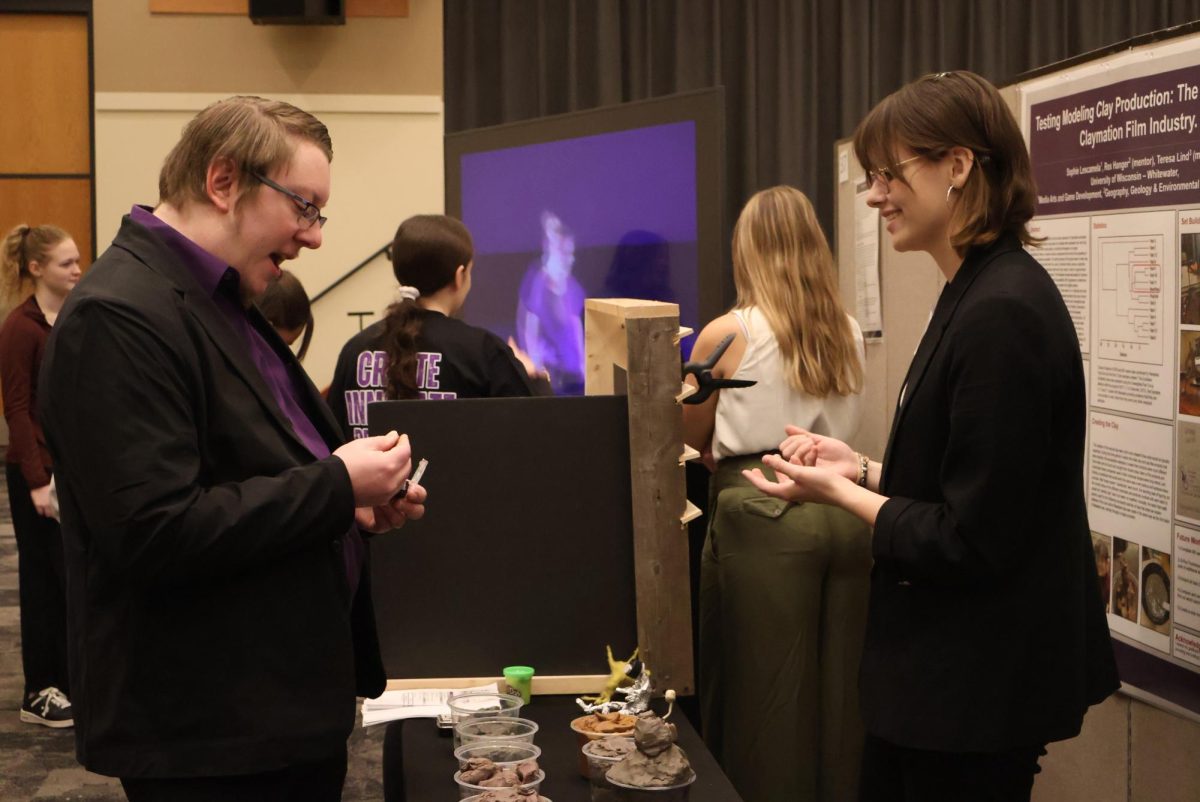
At one end of the Hamilton Room, a television looped footage of a student-performed dance routine. In the middle of the room, another student described how poetry shaped women’s political influence in the Heian court. At the other end, two students recounted traveling the state to track mayfly records. Together, the three projects are a snapshot of the range of work displayed at Undergraduate Research Day.
The University Center hosted the University of Wisconsin-Whitewater community on Nov. 20 for Undergraduate Research Day. Organized by the Undergraduate Research Innovative and Creative Activities Program (URICA), the event highlighted research and creative works that students spent months or even years developing.
The program was known as the Undergraduate Research Program, but was recently renamed to Undergraduate Research Innovative and Creative Activities Program. That change signaled that research extends beyond the lab and data. The shift was visible at the event: for the first time in years, students from all five of UW-Whitewater’s undergraduate colleges were in attendance.
“Since I’ve taken over as director, that’s been one of my goals,” URICA director John Frye said. “In the past, we’ve been heavily dominated by the [natural] sciences and social sciences, and we’ve put forth a very strong effort to try to build those relationships into the other colleges that may not think they do research, but do creative things that involve research.”
Beyond URICA’s effort to encourage involvement of all disciplines, faculty members have been building cross-department relationships that laid the groundwork for many of the projects on display.
In 2023, Newclay Products, a leading supplier of oil-based clay, closed after its owner, Lewis Newplast, retired without finding a buyer. The closure left a gap in the claymation and stop-motion animation industry. Junior Sophie Lescamela’s research combined geology and art to recreate and improve upon Newplast’s formula.

“I was able to get a sample of [Newplast’s clay], as well as samples of other clays from companies that are still doing well,” Lescamela said. “I’ve been analyzing them, figuring out the different properties, the different chemicals, what materials used inside them give them what qualities. And I’ve been making my own batches. … I’ve been studying them and trying to make the best type of clay that would really stop the death of the claymation and animation industry.”
As people attempt to cross the U.S.-Mexico border, many die from the extreme heat, drown at the fast-moving Rio Grande or sustain deadly injuries through the harsh terrain. Those deaths create a food source for local wildlife, including birds. Senior Maren McDonnell’s research examined how those bird populations are impacted, but also looked at culture and border policy.
“When these people are dying and ultimately being picked apart by birds they’re not being buried or treated the way that a lot of cultures and religious beliefs wish for their loved ones to be remembered,” McDonnell said. “This can become a big cultural and social thing. That also relates to government and border policy. In the mid 1990s, they started this project called Operation Hold the Line. … When they started doing that, it made migration more dangerous and unsafe for people, so they had to start taking these more dangerous routes, which is where they’re dying.”
Lescamela and McDonnell’s research reflect the philosophy that URICA and the wider campus promote. The Wisconsin Idea, a guiding belief in the UW system, holds that education and research should serve the public good, not just the campus. Many of the projects on display aimed at making change to society, industry and beyond.
“The Wisconsin Idea is not just something that professors and administrators and lecturers and employees say as a thing that’s part of the university, but it’s something that’s part of the DNA of it,” URICA associate director Brian Schanen said. “It’s also in our students and their curiosity and their desire to want to be able to contribute to the fields that they’re studying in: it’s not just stuff coming at them, but that they’re also turning around and innovating and researching and creating.”
The research presented at the event not only shapes student’s fields, but the students themselves. Students gain skills and experience they can apply as they move into their professional or post-undergraduate plans.
“I hope to go on to graduate school for either clinical or counseling psychology,” senior Kalena Winters said. “Often with those Ph.D programs, you need some undergraduate research. So this really helps me beef up my application for that, so that I can hopefully get in. I also would not be opposed to doing research as a job in the future, because I think it’s really interesting, so it’s kind of helped me understand that part of it.”
URICA encourages all students to get involved, and with the university pledging additional support, more students than ever have the opportunity to bring their ideas to life.
