
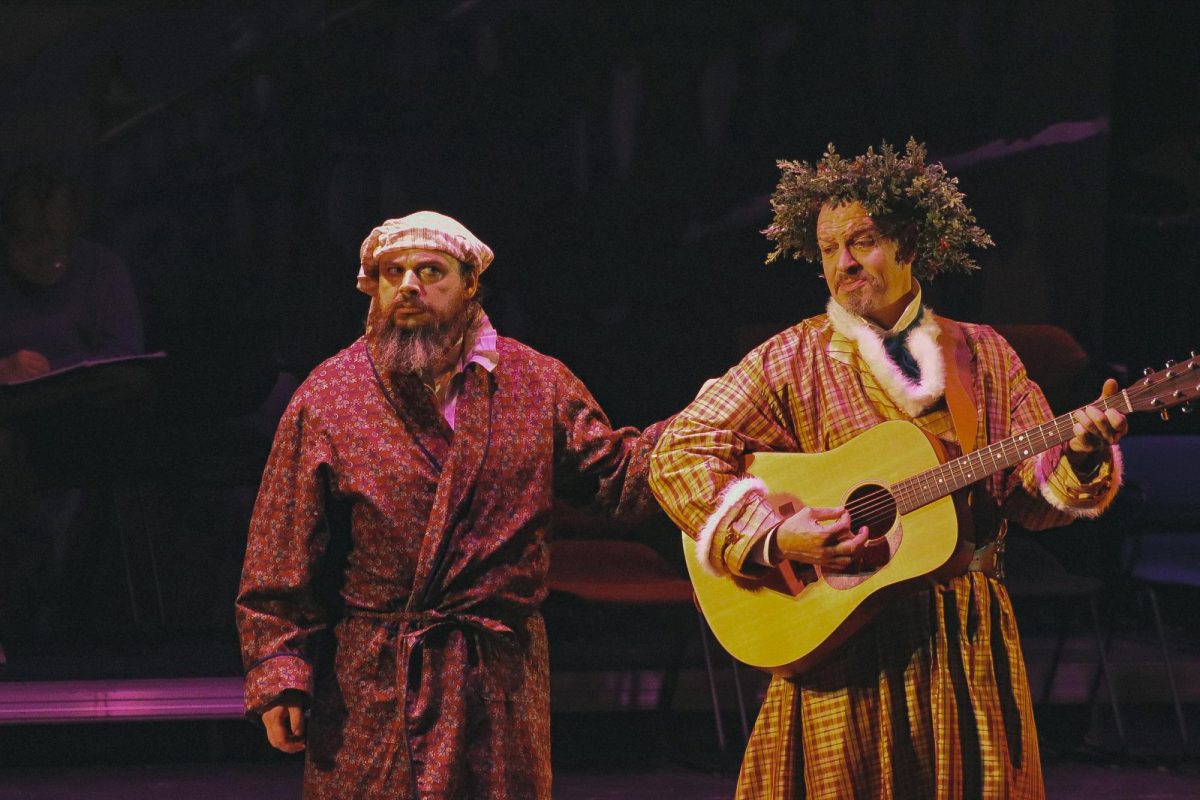
The second and final show of the semester, “Scrooge’s Christmas: A Christmas Carol,” came to a successful end. A classic tale of Scrooge, who starts as a bitter old man who despises Christmas and love, later transforming to a kind and generous man after being visited by three spirits. What led to this classical play transforming into the entertaining performance that the audience members experienced?
Planning
Everything starts with conversations; from the props, set design, costumes and much more, which starts with the director and each designer discussing the script. For this play, these discussions started all the way back in spring. Even between the meetings, communication persisted. New ideas appeared and old ones changed, and this continued even to the final dress rehearsal.
During these meetings, the budget and resources had to always be considered. What could they afford? What should they cut? What is needed and what isn’t? For example, one of the many things that were cut was a fog machine. Not long before the show this was cut primarily because everything was already going well at that point and it wasn’t considered a necessity.
One of the many decisions the director made was to strip the stage down so the audience is able to see backstage.
“Since we don’t have a huge budget, that suited things rather well,” Appleton said. “The director also wanted to do it kind of [to celebrate] the fact that it is a theatrical experience.”
As a result, audience members were able to see the actors changing costumes or even the backstage crew pulling a rope system to make ‘snow’ fall.
Theater Space
Unlike how the Barnett Theatre is typically used, the space was used quite differently for this show. One of those notable differences were seating on-stage for audience members. Another way they utilized the Barnett Theatre differently was by utilizing the entire space for the actors.
“The action of the play takes place all around the inside of the Barnett,” director Bruce Cohen said. “It’s taking place in the aisles and up near where the handicap seating is; on the upper right, and the upper left; in addition to what’s going on on-stage.”
Both the decisions to show the backstage to the audience and utilize the entire space for the actors, were to help bring the audience into the story and immerse Scrooge’s world with our own. After all, it’s a show to experience, not just watch.
Songs
Even before the scheduled time for the beginning of the play, the performance had already started. What began as a single actor sweeping on stage led to joyful singing from the entire cast. In the half an hour before the show, the actors sang “Over the River and Through the Wood,” “Daisy Bell (Bicycle Built for Two),” and “My Old Man (Don’t Dilly Dally on the Way).” Not only that, the actors, who were still in-character, personally interacted and invited audience members to sit in the available seats on-stage.
However, those weren’t the only songs performed. Throughout the performance, many other pieces made an appearance, some more recognizable than others. The play started with “God Rest Ye Merry, Gentlemen,” while an actor spoke about Old Marley who’s dead. As dead as a doornail. Later on the actors would sing “Carol of the Bells,” “O Holy Night,” “Deck the Halls,” and many more.
Actors
Although preparing for a role may differ depending on the actor, they all start somewhere: the script.
Luckily, for this performance, all of the actors were able to look over their scripts during the summer. For most shows, such as “Eurydice,” the first play of this semester, this wasn’t available.
Not long after “Eurydice” concluded, rehearsals began. “[For the actors], we have a 6-day-a-week rehearsal process,” Cohen said. “We meet Monday through Saturday nights, 7 to 10 o’clock at night. Once we hit the technical rehearsals we’re pretty much seven days a week, and most of those days are six to eight hours.”
For some actors, this show was their final capstone project. Despite the bittersweetness, this provided the perfect opportunity to utilize the skills they’ve been growing the past four years and showcase their effort and passion for theater.
One of the new things both new and experienced actors had to learn was audience members on-stage in the Barnett Theatre. With the help of numerous rehearsals and Professor Cohen’s notes made the process much easier to learn.
“[The actors] are engaged with the audience, and [they] are getting to share these feelings with them and that is something I love,” said Core Miller, senior and actor of Bob Cratchit. “Given that it is such a heartwarming show, and you’re supposed to see Ebenezer Scrooge [as] this mean, nasty old man; greedy and thinks about himself. Then he has this beautiful change and reformation, and you really want to feel with him… being this close and being able to really feel that intensity, it’s a great environment for this type of show.”


