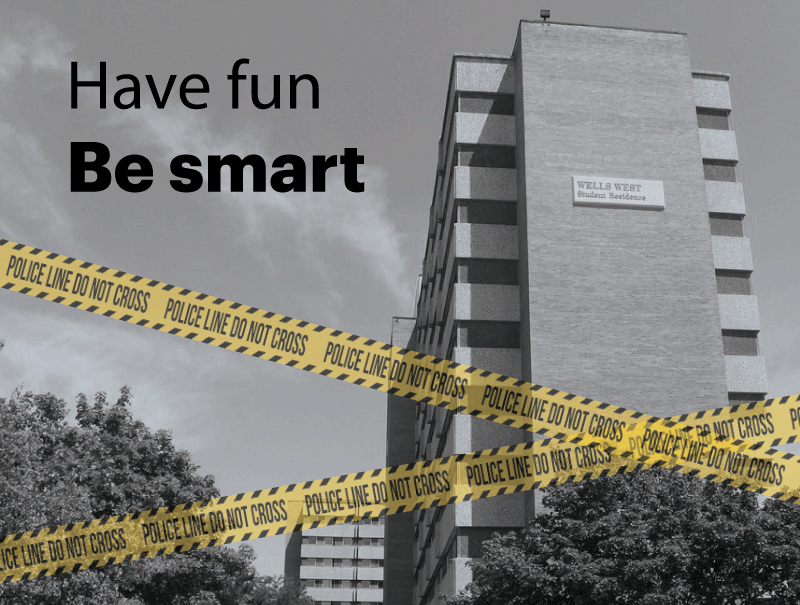
As the 2026 spring semester commences at UW-Whitewater, thousands of students rush to lectures, flood residence hall lobbies and make campus life electric in their own ways. This swamping coincides with a common uptick in inappropriate activity, which concerned students and their families during the opening weeks of the 2025 fall term.
The university received three Timely Warning notifications within the first 17 days of the semester, issued in compliance with the Jeanne Clery Campus Safety Act. The first notification came after a Sept. 6 sexual assault in Wells West, the second after extortion attempts in Wells East the same day, and the third after several on-campus electric scooter thefts between Sept. 10-19. Furthermore, an off-campus gunman was spotted near Wells Sept. 26.
These early crimes caused disarray among the UW-W campus community. The immediate reaction of the Police Department and other associated faculty needed to uplift students and make them feel safe on campus.
Three days after the two Wells incidents, Wells Hall transitioned to 24/7 locked access, similarly to every other residence hall. Prior to this change, lobby entrances were open during the day to allow access to the University Fitness location in the basement. Students with a University Fitness membership could still use their HawkCard to access Wells. This limited access will remain in effect in Wells Hall to begin the 2o26 spring term.
UW-W Police Chief Matt Kiederlen acknowledges that even with stricter restrictions, students will still stand outside residence halls and wait for the door to be open so they can enter the building without access. He believes that a mentality switch could prevent this from happening.
“Look at it as your own home environment, which is oftentimes hard for people to do,” Kiederlen said. “The reality is, you need to think in the way that you would protect your home. You’re not going to let somebody in your front door that you don’t know or who doesn’t have appropriate access at your home.”
Foot patrol also increased throughout the building, primarily to speak with witnesses of the extortion incident. The investigation was prolonged because police did not receive word of the incident until well after it occurred. As a result, no specific security measures will be in place as students return to campus.
“The saying I utilize is I’d rather have our officers investigate 1000 nothings than miss the one something,” Kiederlen said. “But we can’t do that without the cooperation of our community.”
As for the electric scooter thefts, multiple individuals were arrested after being caught with a stolen scooter. The university saw a significant decrease in these thefts following these arrests, although there is not a direct correlation.
Kiederlen also asked the community to “secure their valuables as a theft deterrent” in his message about the thefts. The Clery Act legally requires these messages to contain prevention tips like this, which helps students, especially newer ones, understand their role in hampering crime on campus.
“Prevention is only as good as what everyone else is doing,” Kiederlen said. “We can provide people the tools and the capability, but we are never going to be everywhere all the time. Police can prevent crime to a point.”
Kiederlen asks students to cooperate with officials and call 9-1-1 if they feel like something is not quite right. Furthermore, police are available to be problem solvers and can aid students in training and education. The most important security measure is student collaboration.