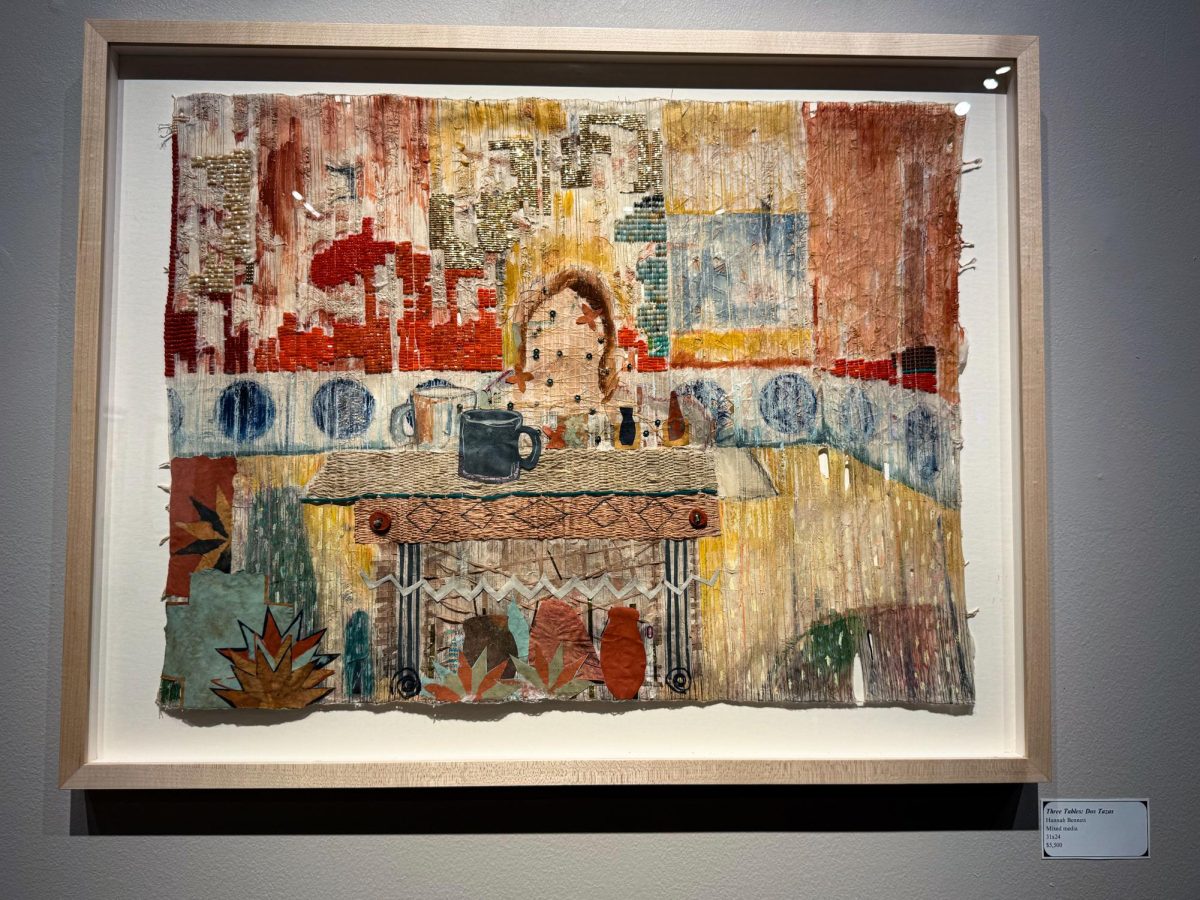
Community members from campus and outside all arrived at Roberta’s Art Gallery in the University Center Feb. 17 for the “At the Table: People, Places and Things/A la Mesa: Gente, Lugares y Cosas” exhibit reception, featuring works by Hannah O’Hare Bennett.
Before coming to Roberta’s Art Gallery, Bennett was recently awarded a 2025 Women’s Artist Forward Art Prize and showed her work at the Wisconsin Museum of Art, the Dubuque Museum of Art, the Penland Gallery and more.
Art is often an incredibly personalized experience for people. Everybody’s view on a piece can vary from others, even the artist, depending on their experiences or emotions before walking into the exhibit.
“This is a very personal experience of how Hannah interpreted her own work, whereas other people might connect with a different part of Ecuador or a different part of traveling internationally and spending time with any Latin American sitting at the table, and how that cultural element is so important to their experience, to relationships and people,” Roberta’s Art Gallery manager Tonia Kapitan said.
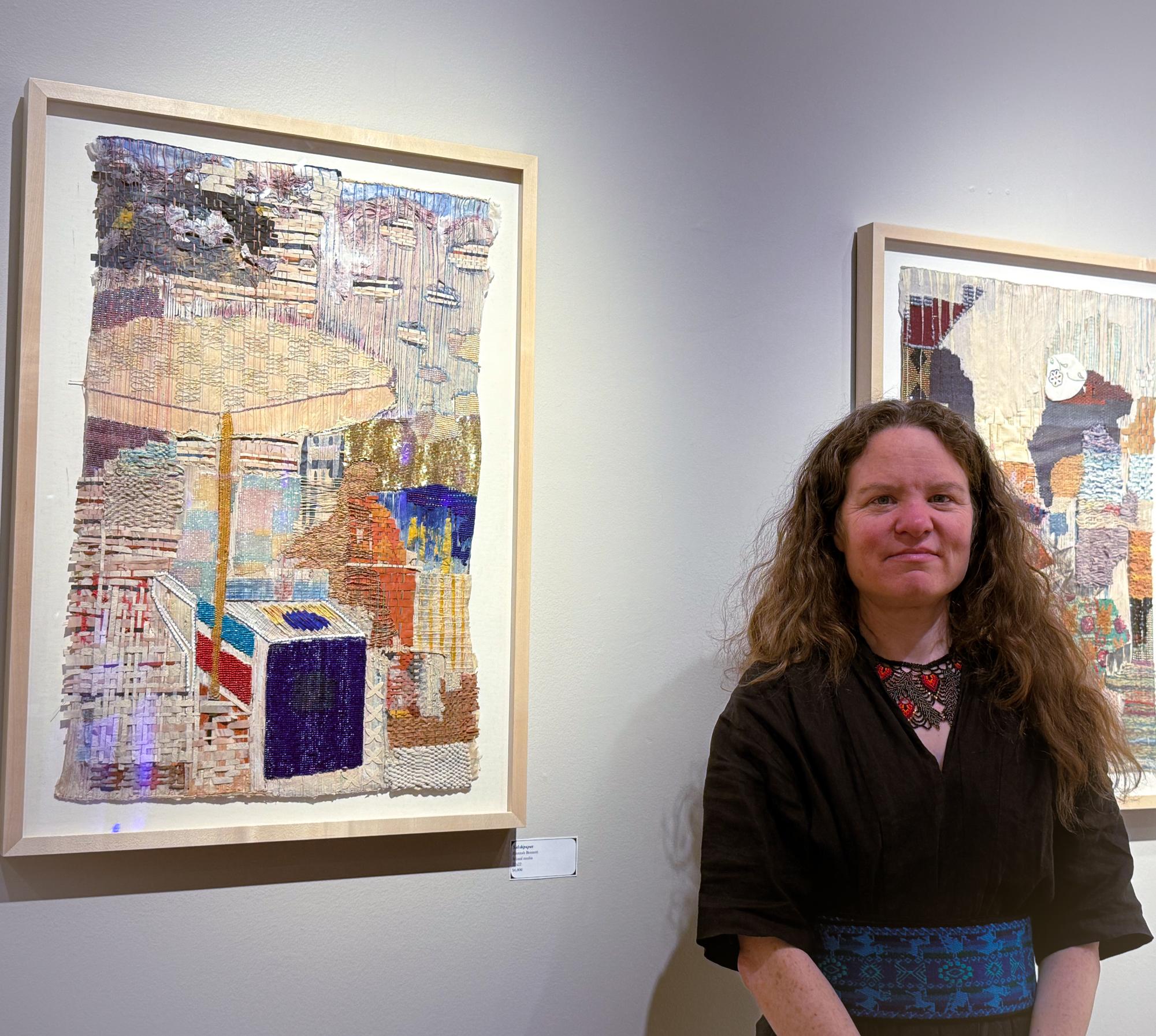
(Karissa Dieterich)
During the reception, Hannah O’Hare Bennett answered a list of questions in a Q&A session, and afterward answered any questions that the audience may have regarding her works, practice or time in Ecuador.
Unlike many other works that have been presented at Roberta’s, Bennett’s work involves detailed tapestries, utilizing colored papers and many other materials that she has on hand to create her works. They are inspired by her two years living in an Ecuadorian village as a Peace Corps volunteer. It is especially rare for the gallery to see an artist doing papermaking at the level that Bennett is.
The Peace Corps has been around for 65 years, with volunteers and a cultural exchange program that lasts for two years. In Bennett’s case, she applied 22 years ago and was sent to Ecuador with no Spanish speaking skills. While she was taught the basics of living in Ecuador, she had to get to an intermediate level of Spanish.
“I did feel really disoriented, and when I first got to the site I was assigned to, I would find things that made sense,” Bennett said. “Find phrases that I would recognize from what people were saying to me, and sort of hold onto that, and then my worldview would sort of form around it.”
When she first started her unique technique to create her work, she took film photos she had taken in the past while in Ecuador, held them up to a window to create line drawings, then based her weaving on those drawings. While her pieces bear some resemblance to the photographs, they were not identical.
While her works may appear obscure and abstract without a purpose, once you take some time to look at each piece, you will begin to spot recognizable images, such as a cup or a person.
“I’ve spent many hours around tables,” Bennett said. “I feel like it’s so ingrained in my thought process that it’s hard for me to pull that out. Food at the table is a part of hospitality and a part of family. Physical environments are very important to me, and they’re tied to feelings of home and comfort. When I think about Ecuador, I think of these very specific places that I’ve lived, and I do feel like that sort of ties into the way that I feel about it [compared] to where [I’ve grown up]. I have equally good home-feelings about both of those places, but [they] still feel different.”