
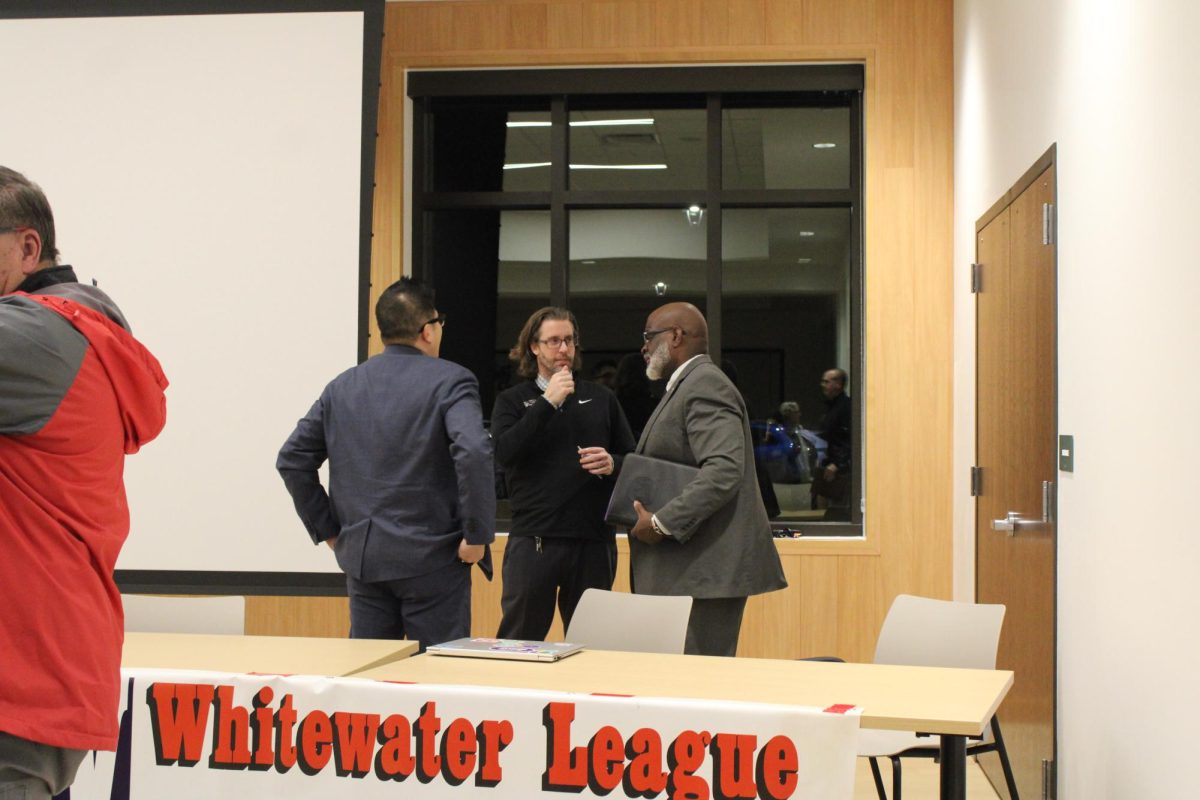
League of Women Voters of Whitewater Area hosted its annual State of the City and Schools event Feb. 19. Members of the community were invited to hear updates from local city leaders about progress being made over the past year and goals for the future.
Whitewater City Manager John Weidl, University of Wisconsin-Whitewater Chancellor Corey A. King and Whitewater Unified School District Superintendent Samuel Karns each delivered presentations informing attendees of recent updates and plans moving forward.
Weidl began the evening by highlighting decisions the city has made over the past year. He explained that these decisions were made by a data-driven approach and long-term planning.
“Over the past year our decisions were guided by the data we had, long-term capacity and a shared commitment for aligning resources with needs,” Weidl said.
Housing stability and conditions remain a priority for the city. In 2025, Whitewater saw more than 50 new single-owner-occupied homes developed. The first phase of 120 family-style multifamily housing units is also moving forward, with additional subdivisions positioned for future development.
Weidl said while new housing development is important, maintaining existing homes is equally important. The city is taking steps to preserve current housing, support long-term homeownership and strengthen neighborhoods across the city.
Public safety also continues to be a priority. Police and Fire/EMS departments are responding to an increased number of calls while also improving their response times compared to previous years.
Karns followed Weidl with an update on the Whitewater Unified School District. He said the district has formed a variety of focus groups such as student, business, university and community groups. These groups were formed as a way to gather input and help guide goal setting. The district has also begun to send monthly letters to residents in hopes to improve communication and transparency.
In addition, Karns emphasized the district’s focus on student well-being, quality of education and safety.
“When people ask me what keeps me up at night, I tell them safety,” Karns said. “We are responsible for a little over 1,800 students and more than 300 staff members. My job is to make sure they’re safe, they get meals and most importantly, they’re learning in a safe environment.”
King concluded the discussion by outlining three main institutional focuses for UW-Whitewater: a strategic plan, an academic plan and a budget plan. The university is working towards a goal of enrolling 13,000 students, reeling in 10,000 full-time equivalent students and a retention rate goal of 82%.
“This year we have the largest enrollment growth in a decade and the largest freshman class as well,” King said.
Current retention rates are at 78%, which King noted is higher than recent years. He said continued efforts to improve student success and retention remain crucial to the university’s long-term strategy.
The three presentations offered residents a snapshot of the current progress and set a benchmark for the city’s priorities going forward. Together, the updates reflected a focus on growth, safety and long-term planning across the city, school district and university.
