

Forget the movie Twisters. Students at the University of Wisconsin-Whitewater can experience storm chasing in real life.
Geography 492, an extreme weather travel course, sends students on a two-week road trip across the Great Plains to track severe weather in real time. Led by John Frye, associate professor of geography, geology and director of the Undergraduate Research, Innovative, and Creative Activities program, the course blends science, fieldwork and hands-on learning.
Frye launched the class in 2013 with just eight students, inspired by his own experience as a student at Ball State University.
“I took a course just like this at Ball State University and it really solidified my love for extreme weather,” Frye said. “I wanted to give that same opportunity to my students.”
Since then, Frye has led the trip nine times, traveling in eight of those years after COVID-19 disrupted the schedule. The group averages around 4,500 miles per trip, and Frye has logged more than 40,000 miles chasing storms as a student and instructor.
The 2025 trip added an emphasis on undergraduate research. Environmental science major Sabrina Wolf created a StoryMap documenting both the journey and meteorological conditions behind each storm. Wolf first took the course in 2022, an experience that prompted her to switch her major from business to environmental science.
Over the course of the trip, the group traveled nearly 6,000 miles, spending much of their time in Texas. Each day followed a structured process: analyzing forecasts, identifying a target area and planning safe and efficient travel routes.
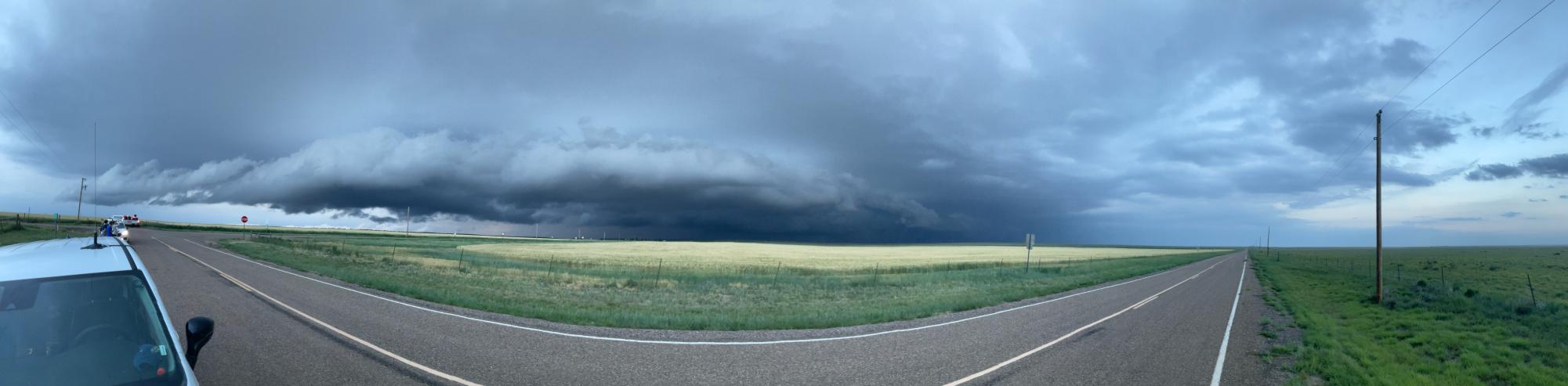
“In Texas, people choose not to build roads for 30 miles and that can turn dangerous fast,” Wolf said.
However, forecasting was only part of the challenge. Students also had to consider practical logistics, where to find food, fuel, shelter and safe observation points while navigating unpredictable terrain and fluctuating conditions.
“We lost service, so we had no idea what the radar looked like. We had to just park on the side of the road to wait out the storm,” Wolf said. “In Texas, there is a lot of dirt, so it just flooded. Just five miles west of where we were the storm was dropping five-inch hail so it was actually pretty good we got stuck.”
At times, the group tracked the same storms as professional teams.
“We were following the same storm as the National Geographic truck,” Wolf said. “We just have minivans, so we don’t feel as fancy. But we were chasing the same storm, so we were at the same level.”
Not every day produced severe weather, but quieter days still offered valuable experiences. Students spent time exploring parks, hiking Palo Duro Canyon and visiting local landmarks.
“We went to Greensburg, Kansas, and saw the largest hand-dug well,” Wolf said. “An EF5 tornado destroyed the entire town in 2007, so even if we were not chasing, we were still learning and experiencing.”
Fieldwork also came with unexpected concerns.

“Dr. Frye always said to watch out for rattlesnakes when we pulled over into the grass and that was scarier than the actual tornado,” Wolf said.
For journalism major Peyton Walz, the course offered an opportunity to tell a different kind of story. Walz produced a documentary, “Beyond the Dry Line,” combining field footage with interviews to make complex meteorological concepts more accessible.
“I wanted to capture life beyond the storm; life on the road, staying in hotels every night and also just having an average person explaining these complex ideas,” Walz said.
The project required months of editing, with most of the work happening in post-production. Footage included a GoPro 360 mounted on the vehicle, along with cameras inside the van capturing real-time discussions via walkie-talkies.
“From a young age, I was terrified of storms,” Walz said. “Anytime I heard wind, I called my mom crying. I’m also not someone very math-and-science-focused. This isn’t just a movie, these storm chasers are scientists.”
Walz said the documentary also addresses the ethical reality of storm chasing.
“We do not celebrate tornadoes ethically,” Walz said. “I did not want to put the celebration of tornadoes into the documentary. This is real life.”
The editing process proved more demanding than expected. Originally the plan was to create a brief 20-minute documentary. However, after the first round of editing, it was three and a half hours long. After a lot of work, the documentary was trimmed to an hour and a half.
The documentary will be shown April 29 in Summers Auditorium, offering viewers a glimpse into both the science and human experiences behind storm chasing.
