The word “fear” represents the larger piece she played.
Soprano singer Rachel Wood sang painfully about the horrific experience of a person in a concentration camp, written in a poem. Wood sang her high notes above the saxophone and piano as they tried to drown her out, but her desperate notes punched through the chaos and into the ears of the audience. She brought tears to the surface and glossed over their eyes as they were brought back to their history lessons in grade school, seeing photos of emaciated Jewish people staring at the camera, begging to be freed.
This piece is one of several performed during the Holocaust Remembrance Concert, hosted by the Department of Music in the Light Recital Hall April 22.
“Music and memory are both deeply personal, yet inherently collaborative, dynamic processes,” UW-W Chamber Singers Director Robert Gehrenbeck said. “As such, performing music of and about the Holocaust is a conscious act of renewal, a re-animation of a memory vital to our survival.”
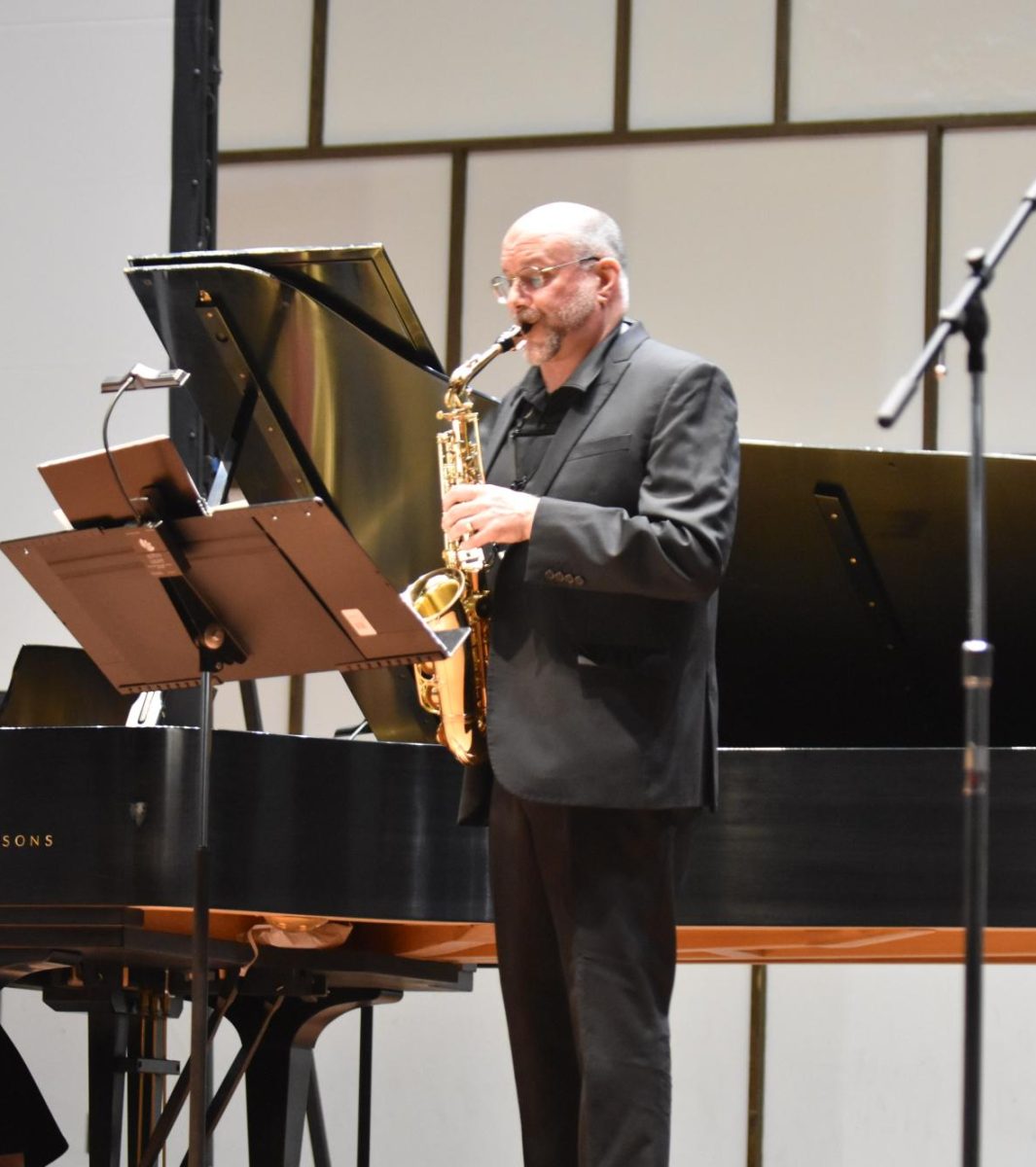
Gehrenbeck was given a script to read in between pieces, sharing the saxophonist Matthew Sintchak’s words on the pieces and the importance of the concert.
“Over one third of millennials believe fewer than 2 million Jews died in the Holocaust. Two-thirds have never heard of Auschwitz,” Gehrenbeck said.
The script of the section ended with the following statement:
“For more than 75 years, people have vowed to ‘Never Forget,’ but memory is a fickle thing. Each generation must decide for itself what is worth passing on to the next.”
This statement shows how important it is to remember history, no matter how horrific, sad or disgusting it can be, so that the future doesn’t mirror the past, but learns and grows.
The concert started with a piece titled “Hot-Sonate” by Erwin Schulhoff, performed by Sintchak and Diana Shapiro on piano. This piece epitomizes the type of jazz music that Nazis hated and wished to silence. The composer was inspired by the rhythm of jazz and his own experience as a prisoner of war in World War I.
“Unfortunately, he never had the chance to leave Prague before he was arrested by the Nazis and sent to a concentration camp in Bavaria,” Gehrenbeck said. “He continued composing inside the camp until he died there in 1942.”
The next piece was titled “I Never Saw Another Butterfly, Op. 11” by Ellwood Derr. This piece featured Wood alongside Sintchak and Shapiro. This piece used a projector for the audience to see the lyrics that Wood was singing, which came from Jews who were in a holding camp before heading off to killing centers.
“Friedl Dicker-Brandeis felt children needed a way to understand what was happening to them, so she decided to organize secret art and poetry classes for them as a kind of art therapy,” Gehrenbeck said.
Before Brandeis was transported to Auschwitz, she gave two suitcases filled with drawings and poems to her friends and loved ones. The composer was inspired by the poetry of the children and set five movements that depicted some of the works that survived.
The first movement is the “Prologue: Terezin,” which expresses hope to be a true child outside of the concentration camp. The second movement, “The Butterfly,” depicts the freedom they wish to have. The third was titled “The Old Man” and shows how they wish to grow old. The fourth was titled “Fear,” which shows how scared the children are. The last movement was titled “The Garden,” which shows how they long to see one and the pretty colors it provides.
The third piece performed is called “The Suspicious Saxophone” by Yehuda Yannay. Sintchak premiered this piece for another Holocaust Remembrance concert back in 2019, where the composer spoke about his experience being in a concentration camp.
“As he closed his talk at the 2019 concert, he said, ‘Human nature, unfortunately, has not changed as much as we might hope. On that somber note, I wish you a beautiful evening,’” Gehrenbeck said.
Unfortunately, Yannay died in 2023. This piece holds his memory and the importance of history as he wrote it based on his own experience, titling the two movements “Degenerate music” (Entartete Musik) and “Lament for Unborn Melodies” (Klagelied für Ungeborene Melodien).
“It depicts the countless individuals who might have created music, poetry, or art, but never had the chance. It is a lament for those unrealized creations,” Gehrenbeck said.
The last piece performed at the concert is titled, “Kol Nidrei, Op. 47” by Max Bruch. This piece brings a meditative ending to the audience, allowing them to soak in the emotions they have felt throughout the concert. Sintchak read the following about this last piece:
“This melody from the 17th century or earlier is known throughout the world and sung in synagogues as part of the first night of Yom Kippur, one of the holiest days for Jews.”
The significance of the original date of this concert, April 15, was that it was the day before Holocaust Remembrance Day. Due to the severe weather, the concert had to be moved. The audience left the hall in murmurs as some cried while others soaked in the moment and history behind the concert.