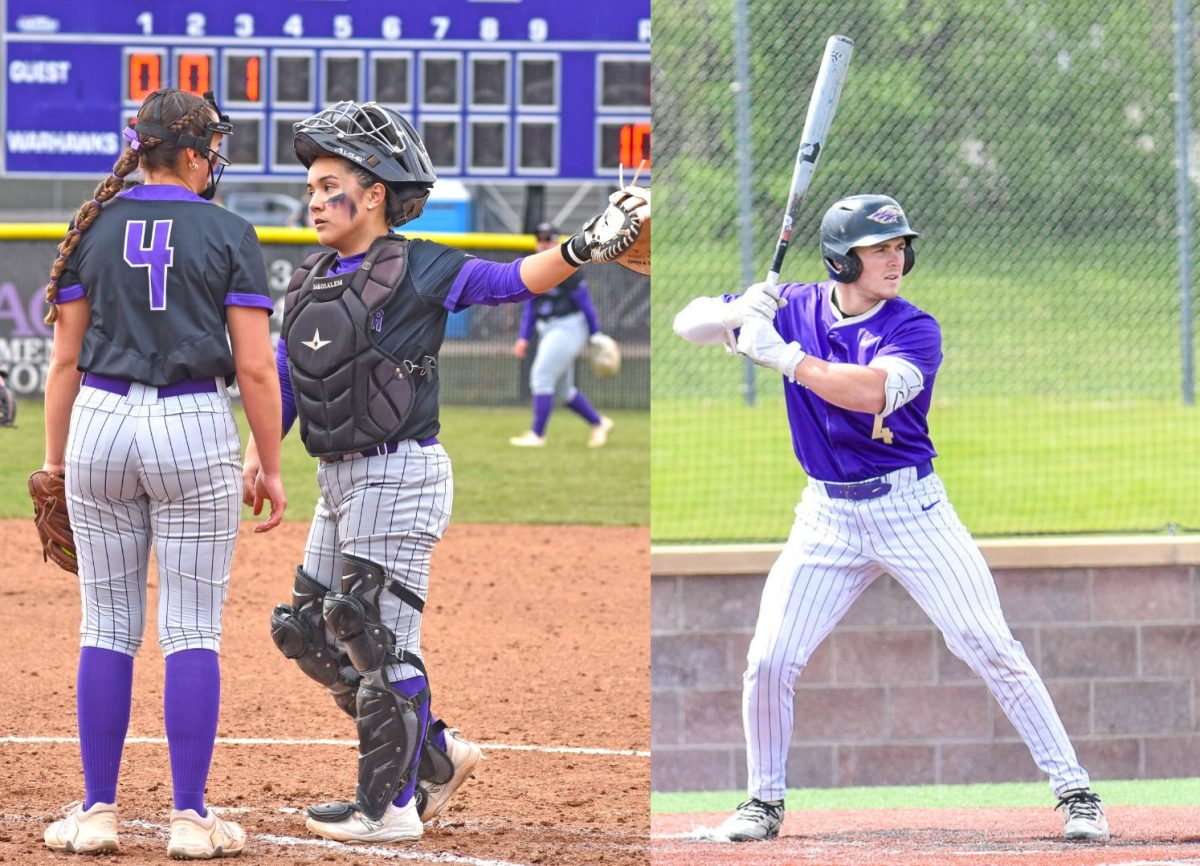
Being the quarterback of the defense is not an easy task. Yet, both Aaron Holland and JJ Jakosalem have found success as the catchers for UW-Whitewater’s baseball and softball teams.
As baseball’s starting catcher, Holland is responsible for identifying opposing hitters’ weaknesses, making counter-adjustments and being a leader for the Warhawks. Over his first two seasons, he has caught 34 runners stealing and has a career fielding percentage of 98.9%. His impact has not only been felt defensively, but at the plate.
In his freshman season, Holland had a slash line of .325/.422/.466. He had 14 extra-base hits, six of them being home runs, while driving in 38 runs. Holland would be a pivotal part of the Warhawks team that year, as they finished as the Division III National Champion runner-up, falling to Misericordia University in the three-game championship series.
The following year, Holland’s numbers increased significantly, as his slash line rose to .401/.455/.652 while he tallied 27 extra-base hits with 14 home runs and 58 runs batted in. The Warhawks would go on to win the Division III World Series, as they defeated Messiah University in two games. For his season-long impact, Holland would be awarded several accolades such as WIAC All-Conference First Team, ABCA/D3Baseball All-Region IX First Team honors and D3Baseball All-American Fourth Team.
But how did Holland get to this point? He, like many others, grew up playing Little League baseball. However, Holland quickly grew bored. It felt like he was standing around more than he was playing, and Holland wanted more action. At the age of 12 he started prioritizing being a catcher.
“I just like being involved in every play,” Holland said. “I like communicating with the defense and pitchers, it’s just a more involved position. At 12, I really started to prioritize catching and it just grew from there.”
Jakosalem has appeared in the majority of softball’s games over the past few seasons. While her offensive numbers may not jump off the page, the defensive impact provided cannot be understated. Jakosalem has thrown out 22 runners over her first two seasons and has a career fielding percentage of 98.6%. She takes pride in the hard work and preparation she puts in to be a steady presence behind the plate.
“To me, a successful catcher is confident in their abilities, communicates well with their coaches and teammates, trusts their team and works hard physically and mentally,” Jakosalem said. “Working hard defensively is super important, like blocking, framing, and throwing accuracy. But it’s also key to make smart decisions and help whenever by making routine plays, blocking balls and throwing out runners.”
There are several aspects to being a catcher. They have the ability to see most of what’s going on in the field, and then have to make adjustments to put the Warhawks in a favorable position. There are several defensive coverages the Warhawks may implement to contain runners or steal an out. However, UW-W’s defenders play at such a high level that it usually makes their job easier.
“For instance, a shortstop might field on his backhand, and he can’t really see where the runner’s at. So if he’s got time, I’ll yell time,” Holland said. “But most of the time our guys are so good on the defensive end that me saying something isn’t really going to impact it.”
They also work closely with the coaching and pitching staffs to develop a gameplan for opposing hitters. Part of this is having a strong relationship with the pitchers, so they can understand their strengths and weaknesses, and clearly communicate any adjustments that need to be made.
“If there’s an adjustment or something we need to do, it’s easier for me to see that just because I’m catching them,” Holland said. “It’s just as important to have an off-field relationship too, just so the communication is more clear or I know I can say certain things to them and they have my trust as far as that goes.”
Developing strong relationships with the guys that he catches has been instrumental in Holland’s career. He makes it a point to spend time with them, whether that’s in the weight room or hanging out together outside of baseball, which helps develop trust between the batterymates.
“It means more when you say something if the guy knows you have their back and they have that trust, rather than me just yelling at them or saying something,” Holland said.
Jakosalem has put the same emphasis on building a strong relationship with her pitchers. For her, it boils down to two key traits: trust and communication. And in order to achieve both, she has to put the time in and connect with the person in the circle.
“I want my pitchers to trust me enough where no matter the pitch, they know that I got their back. The same goes for how I know that they always have my back,” Jakosalem said.
The other aspect of developing a gameplan goes into pitch sequencing – the order of pitches in order to disrupt the batter. While pitching coach Peyton Schnieder is the one that calls the pitches, Holland is frequently relaying what he’s seeing behind the plate. Whether that’s if the pitcher has a certain pitch that’s been effective that given day, go-to pitches based on the count, or the hitter’s tendencies. Hitters may be off of the plate or crowding it, they may be late on fastballs or super early, or it comes down to how much contact they’ve been able to make.
“It’s just having conversations with my coach and giving my input. ‘This is what I’m seeing. This is what the hitters are doing. This is what I think we can do,’” Holland said. “But it just comes back to what the pitcher’s strengths are and what they’re able to execute on a given pitch.”
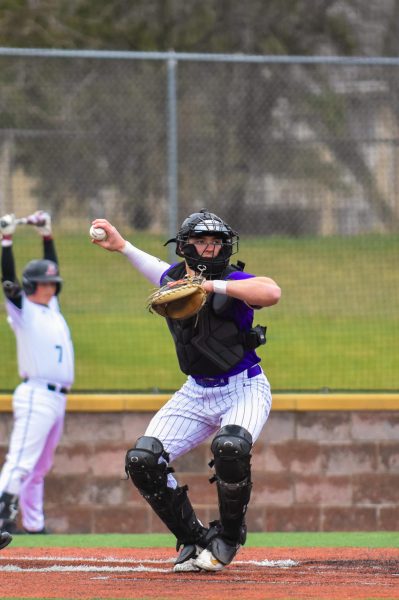
(Charlie Clark)
Conversely, Jakosalem focuses on pitch framing – the art of presenting a pitch to get more strikes called, as well blocking, which is key for not allowing runners to have an easy opportunity to swipe an extra bag. Practice is fundamental to improve these areas of her game.
“It’s about getting your reps in at practice and knowing the types of hitters and base runners we’re facing. This allows me to mentally prepare for the game and ready myself for potential plays,” Jakosalem said.
Through extensive practice, Jakosalem is adequately prepared for the various situations in a game, whether that’s someone trying to steal, a hit and run situation, or if a batter drops a bunt.
“We spend a lot of time in practice working through different situations to the point where it all becomes muscle memory and instinct. The key is listening and trusting my teammates and coaches,” Jakosalem said.
Over the past few seasons, Holland has thrown out several runners. For almost every batter that successfully steals a bag on him, one gets caught. The key to Holland’s success throwing out runners relies on his baseball IQ and confidence. Before games, Holland will look up the stat sheet and identify the opponent’s top runners. During games, he keeps an eye on how a baserunner takes their lead and how aggressive they may be.
“For catching so long, you just get a feel of how a guy takes a lead and how aggressive they’ve been. It also depends on the situation, if we have a big lead teams won’t run as much. In a close game or late in the game, they may try to get something going,” Holland said. “It’s just feel for the game and understanding the situation. I have a lot of confidence in my ability to throw guys out.”
Being a catcher can be physically and mentally exhausting, and it usually is for most. However, both Holland and Jakosalem have been able to manage the physical aspect with ease. As for the mental aspect of catching, that’s been more of a challenge for Holland, as he has to consider his pitcher, the opposing batter and worry about how the defense is positioned.
“A lot of it is taking care of your body and eating right. I feel like I’m ready to go every game,” Holland said. “The mental grind is probably the toughest part.”
To keep herself healthy, Jakosalem spends considerable time in the weight room and makes sure that she stretches thoroughly before practices and games. With how often she throws in games, she makes sure to take care of her arm.
“Recovery is huge in staying healthy. I do this by prioritizing sleep, proper nutrition and overall rest. Managing the physical demands is the easy part,” Jakosalem said.
Being a strong leader is vital for Holland. He wants to be the one to set the tone and lead both vocally and by example. This has been an area that Holland has developed the most since his freshman season. When he first started playing for the Warhawks, he was less vocal, and someone who would do more listening. As time passed, he grew more vocal and started assuming more leadership responsibilities.
“Everyone’s looking at you on every given play. How you act matters. The biggest thing you can do is be a rock for your team,” Holland said.
As the postseason approaches for their respective sports, both Holland and Jakosalem look to be pivotal parts of the Warhawk lineups and continue to be a sturdy presence behind home plate.