
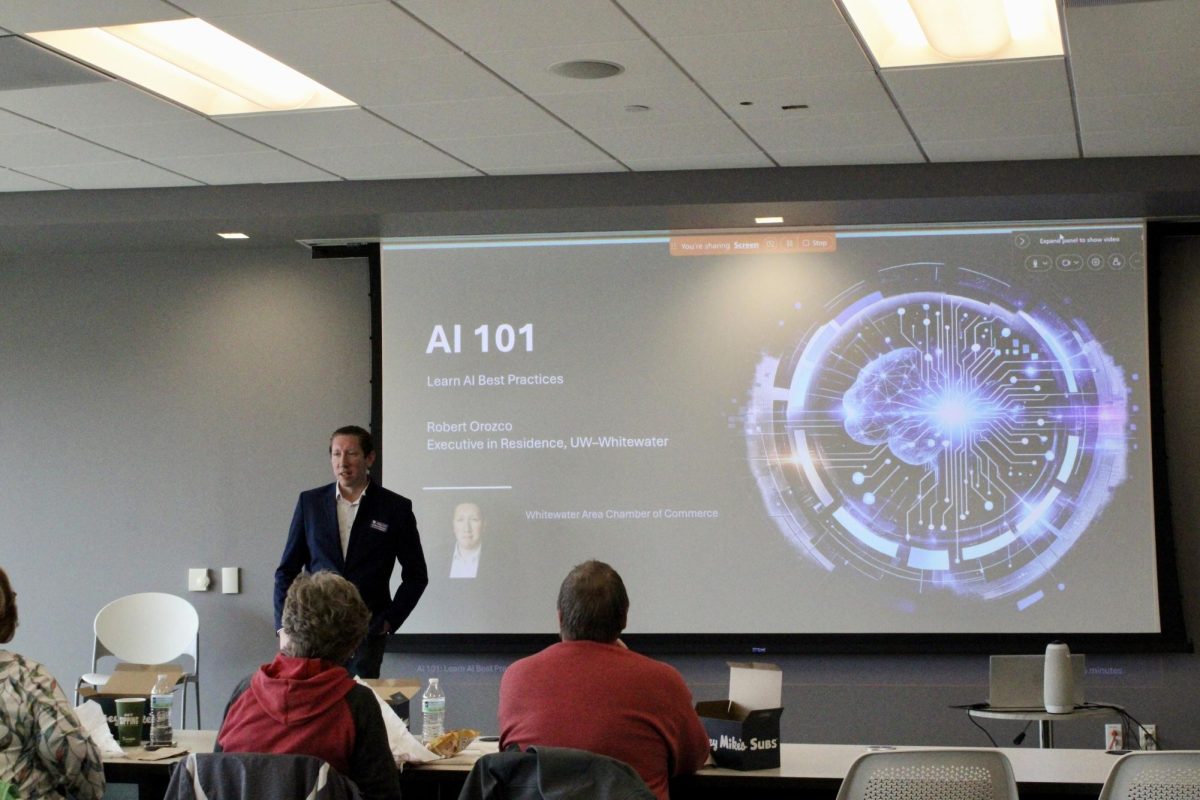
The Whitewater Chamber of Commerce hosted “AI 101” March 3. The event helped community members and business owners better understand how to utilize artificial intelligence technology in practical and responsible ways. The presentation focused on education and adaptation, encouraging attendees to use AI as a supportive tool.
University of Wisconsin-Whitewater executive in residence Robert Orozco led the presentation. He emphasized that clear communication is key when using AI. The more descriptive and specific a user is, the better the results will be. Providing relevant information and necessary context allows the system to properly perform a task. Orozco encouraged attendees to establish a goal before using the tool and think about what outcome they want.
He also explained that some platforms serve different purposes. For example, X’s Grok and Google Gemini are more effective for producing images than other AI sources. Understanding the strengths and weaknesses of each source helps users pick the right tools for their preferred outcome.
Beyond generating content, Orozco described AI as a helpful assistant for brainstorming, research and organization. It can summarize meetings, build templates and critique work. However, he noted to use caution when it comes to data-heavy tasks such as spreadsheets because that’s when it begins to make mistakes.
Tourism in Whitewater is already seeing AI’s assistance in everyday tasks. Discover Whitewater executive director Karin Silvius explained how AI has supported her work.
“In the tourism world, it’s creating itineraries for people, specifically with restaurants and the university,” Silvius said. “It can tell people where to go, how to do it and what time.”
Orozco addressed safety concerns, stating that users should never share personal information such as passwords or Social Security numbers. Because AI systems learn from data, there is a potential risk in sharing sensitive information. Orozco reminded attendees that AI can get things wrong and encouraged them to ask the system what assumptions it is making. Doing so can help identify misinformation and redirect it toward a more accurate answer.
“I would like to see AI being used to provide as many services and advantages as possible,” Orozco said. “I would love to see the way that UW-Whitewater integrates it to specialized student learning and improving services for the community.”
This new technology may seem intimidating to some, but rather than replacing opportunities, community leaders say that AI can open doors. Innovation Services and Community Engagement Center executive director Elizabeth Thelen explained that AI can enhance productivity, but nothing can replace humans.
“There is always additional opportunity for talent, and AI may create new opportunities,” Thelen said. “There are more things to be created and to do, but human talent will always be needed.”
Speakers agreed that AI works best when guided by human judgment. By using it carefully, setting clear goals and double-checking results, Whitewater residents and businesses can adapt to new technology.
In Whitewater, artificial intelligence is no longer a distant concept. It is becoming a tool for local businesses, tourism leaders and educators. As the community learns to guide the technology rather than fear it, AI is becoming less about uncertainty and more about possibility.
